"They had Stone Age technology, but their vision was millennia ahead of their time. 5,000 years ago the ancient inhabitants of Orkney, a fertile, green archipelago off the northern tip of modern-day Scotland erected a complex of homes and monumental buildings unlike anything they had ever attempted before." - National Geographic, August 2014.
"Life in Stone Age Orkney was far more refined than once imagined. The well-built homes at Skara Brae, Europe's most complete Neolithic village, included stone hearths, beds, and cupboards."
The tradition and craft of stone masonry continued throughout Scottish history. In medieval times guilds, similar to unions today, were formed to protect the interests of the stone masons. This guild survives today in the form of the society of Freemasons. My grandfather Dewson who was born in the north of England near the Scottish border joined the Freemasons - rather than a church - when he came to homestead in Saskatchewan, Canada in 1905.
In Scotland, the superb artistry of the stone masons is evident.
This is a knotted rope around a window of the Wallace Monument. Wallace is a Scots hero and legend.
This is a statue in Edinburgh representing Canada. Scots were among the first settlers to our country, and they brought their craft with them. They constructed many of our finest and most important buildings out of the plentiful and varied stone they found here.
This is The Centre Block with the Centennial Flame at Canada's Parliament Buildings in Ottawa. It is known as one of the finest Gothic structures in North America, and was near completion around 1865. Many quarrymen and stone cutters from Scotland where the trade flourished were imported to meet the demands of its construction.
Stone from Ontario, Quebec, New Brunswick and Manitoba as well as some from Europe and the U.S. was brought to the banks of the Ottawa River to build this magnificent monument.
Scottish stone masons and their artistry have left their enduring mark on grand buildings in important cities across our province of Ontario.
Sunday, 25 January 2015
Tuesday, 20 January 2015
Manifesto
I began my Google+ website on March 8, 2014, with doubt. I wanted to post only my own work, and my own thoughts. This was not to be a Pinterest-style blog, with images borrowed from more famous Designers.
So I called it "Classic Design or Trend," because, after a lifetime of developing both my visual and linguistic skills, I saw the light! All of my work is valid, not just what appears as the latest example of a trend I might have riffed off. If it's valid, then ergo it's valid.
My mother had exceptional artistic talent which she never used professionally. I absorbed through my skin the ambience of every environment she created. Like her, I have "perfect pitch in colour." I have always been able to discern the components of any mixed colour, just by looking at it. I also have her impeccable ability to place three-dimensional objects spatially in perfect harmony.
I want to show you the 3 sides of a clay pot my daughter painted for me long ago, and which always sits where I can see it daily. No one but me knows this, but I turn the pot to one of its 3 sides, according to what I'm going through emotionally and spiritually at any given time. This pot shows Sacred Symbols of the Celts.
I am genetically mostly Celtic, with many drops of "the other," since my family has been on this continent for a long, long time. I have a feeling for this land.
I have been through a period of Fire, where at my age of maturity, I began to gather up all of my experiences and skills gained through my lifetime into a whole.
The process of doing so involved much introspection and often excruciating pain, descending into the belly of the whale, if you will. I was alone with my thoughts and the meditations of my heart for a long time. This is The Cauldron of Rebirth.
So I called it "Classic Design or Trend," because, after a lifetime of developing both my visual and linguistic skills, I saw the light! All of my work is valid, not just what appears as the latest example of a trend I might have riffed off. If it's valid, then ergo it's valid.
My mother had exceptional artistic talent which she never used professionally. I absorbed through my skin the ambience of every environment she created. Like her, I have "perfect pitch in colour." I have always been able to discern the components of any mixed colour, just by looking at it. I also have her impeccable ability to place three-dimensional objects spatially in perfect harmony.
I want to show you the 3 sides of a clay pot my daughter painted for me long ago, and which always sits where I can see it daily. No one but me knows this, but I turn the pot to one of its 3 sides, according to what I'm going through emotionally and spiritually at any given time. This pot shows Sacred Symbols of the Celts.
I am genetically mostly Celtic, with many drops of "the other," since my family has been on this continent for a long, long time. I have a feeling for this land.
I have been through a period of Fire, where at my age of maturity, I began to gather up all of my experiences and skills gained through my lifetime into a whole.
The process of doing so involved much introspection and often excruciating pain, descending into the belly of the whale, if you will. I was alone with my thoughts and the meditations of my heart for a long time. This is The Cauldron of Rebirth.
I emerged from this trial to fully own The Mother Goddess. Now my passions work together in complete congruency. Notice the dark centre of our power as women which the Celts knew to worship. We are the symbol of the night, the mystery of the unknowable, and the source from whom all forms originate. We are the black in the yin/yang which contains the white dot.
We are beyond all distinctions and we dwell in the realm of love.
Thursday, 8 January 2015
Representing African Heritage: Genius Reinvented
Owen Gordon has worked with Mokonde wood carvers from Africa in a cultural exchange program in Jamaica. He has developed an internationally recognizable form of unique, elongated, carved wooden figures.
Owen's first one-man exhibition of sculpture was held at the Creative Arts Centre. U.W.I., St. Andrew, Jamaica. His paintings and sculpture have been exhibited in several international art shows in England and the U.S.
Representing African Heritage featured many of Owen's vivid paintings and sculpture. Owen also created 7 black pedestals to display his work, 3 long and tall, and 4 shorter and wider. These pedestals were made to perfection, with the highest level of craftsmanship.
Here is one last, long, look at a powerful assemblage of Owen's sculptures on their pedestals. His work filled most of one of the three galleries that took up one entire floor at 80 Spadina for this historic exhibit, the first of its kind in Toronto to celebrate Black History Month, in February 1995.
I produced all aspects of Representing African Heritage in Contemporary Art with the partnership of Hollis Baptiste aka Awalay. This historic show paved the way for all future corporate-sponsored art exhibits later assembled to honour Black History Month. Similarly inspired exhibitions now occur with regularity every February.
Be sure to watch for these this coming month, Black History Month, February 2015.
Owen's first one-man exhibition of sculpture was held at the Creative Arts Centre. U.W.I., St. Andrew, Jamaica. His paintings and sculpture have been exhibited in several international art shows in England and the U.S.
Representing African Heritage featured many of Owen's vivid paintings and sculpture. Owen also created 7 black pedestals to display his work, 3 long and tall, and 4 shorter and wider. These pedestals were made to perfection, with the highest level of craftsmanship.
The aim of Representing African Heritage in Contemporary Art was to show that the genius of Africa continually reinvents itself, while retaining the vibrant palette, the ease of geometry, the mastery of abstraction, the sense of great energy in containment that are the unique properties of African art. Its aim was to excite your eyes and kindle your imagination.
Here is one last, long, look at a powerful assemblage of Owen's sculptures on their pedestals. His work filled most of one of the three galleries that took up one entire floor at 80 Spadina for this historic exhibit, the first of its kind in Toronto to celebrate Black History Month, in February 1995.
I produced all aspects of Representing African Heritage in Contemporary Art with the partnership of Hollis Baptiste aka Awalay. This historic show paved the way for all future corporate-sponsored art exhibits later assembled to honour Black History Month. Similarly inspired exhibitions now occur with regularity every February.
Be sure to watch for these this coming month, Black History Month, February 2015.
Friday, 26 December 2014
Poet as Priest: Auld Lang Syne
I had the privilege and honour of presenting Clifton Joseph and Jerome Morgan in a class I organized, February 2010, for African History at the Academy for Lifelong Learning. Academy classes are held at Knox College, St. George Campus, University of Toronto.
The subject I chose was the West African griot tradition and how it reappeared, changed form and evolved in North America and the Caribbean, the African diaspora. In West Africa, the griot is historian, story-teller, praise singer, poet and/or musician.
I linked it to classic rap which is what I am most familiar with, and at the beginning of the class played some on my ipod: early Queen Latifah, Run DMC, and Quincy Jones, "The Verb to Be."
Then Jerome Morgan gave us his poem of early memories of Jamaica. Jerome was mentored by d'bi young of the Dub Poets Collective.
Clifton Joseph, founding member of the Dub Poets Collective, ended the set. To my surprise, and probably everyone else there, he chose to sing the old Scottish Robbie Burns folk song written in 1788, Auld Lang Syne. He ended his song in tears.
There is a traditional dance that accompanies the singing of this song to ring in the New Year. All persons cross arms over their chests and thus over their hearts to hold hands with their neighbour on either side and move the circle so formed inwards.
Somehow, as this dance continues, the circle participants then invert their arms to face outwards, and the circle moves in that direction.
The community forms a circle of protection, and then faces and moves outwards to welcome in the New Year, and the returning of the light.
In ancient Egypt in northern African, the blue lotus symbolized the sun and its return each morning. It also represented the larger cycle of birth and rebirth.
The lotus is found in many major cultures. In Buddhism, the pink lotus symbolizes the beauty of Enlightenment, purity and the cycle of creation.
At one time I had painted on my dining room ceiling the outer circle of a central Sun motif, originally painted on an American aboriginal bison robe.
So, now that the year is ending, we have seen the Winter Solstice, and we welcome back the sun and the beginning of a new year, new life and new creation, as every culture has done before us.
And mostly, we recall and often shed tears in memory of those whose shoulders we stand on.
The subject I chose was the West African griot tradition and how it reappeared, changed form and evolved in North America and the Caribbean, the African diaspora. In West Africa, the griot is historian, story-teller, praise singer, poet and/or musician.
I linked it to classic rap which is what I am most familiar with, and at the beginning of the class played some on my ipod: early Queen Latifah, Run DMC, and Quincy Jones, "The Verb to Be."
Then Jerome Morgan gave us his poem of early memories of Jamaica. Jerome was mentored by d'bi young of the Dub Poets Collective.
Clifton Joseph, founding member of the Dub Poets Collective, ended the set. To my surprise, and probably everyone else there, he chose to sing the old Scottish Robbie Burns folk song written in 1788, Auld Lang Syne. He ended his song in tears.
"Should old acquaintance be forgot and never brought to mind
Should old acquaintance be forgot, and auld lang syne...
But we've wandered many a weary foot, since auld lang syne...
But seas between us broad have roared since auld lang syne.
And here's a hand, my trusty friend! And give us a hand o'thine!
And we'll take a good-will draught, for auld lang syne."
There is a traditional dance that accompanies the singing of this song to ring in the New Year. All persons cross arms over their chests and thus over their hearts to hold hands with their neighbour on either side and move the circle so formed inwards.
Somehow, as this dance continues, the circle participants then invert their arms to face outwards, and the circle moves in that direction.
The community forms a circle of protection, and then faces and moves outwards to welcome in the New Year, and the returning of the light.
In ancient Egypt in northern African, the blue lotus symbolized the sun and its return each morning. It also represented the larger cycle of birth and rebirth.
The lotus is found in many major cultures. In Buddhism, the pink lotus symbolizes the beauty of Enlightenment, purity and the cycle of creation.
At one time I had painted on my dining room ceiling the outer circle of a central Sun motif, originally painted on an American aboriginal bison robe.
So, now that the year is ending, we have seen the Winter Solstice, and we welcome back the sun and the beginning of a new year, new life and new creation, as every culture has done before us.
And mostly, we recall and often shed tears in memory of those whose shoulders we stand on.
Tuesday, 16 December 2014
Representing: Artist as Shaman
Representing African Heritage featured the artist Ras Stone, now known as Jah Stone.
He is well known for his Caribana costume design. His costumes have appeared in the Royal Ontario Museum (Quatzelcoatl-Canadian Celebrations, 1991) and Harbourfront (Sun God Worshipper - Festival of Lights, 1993).
His painting "Dread Preacher" was used by Saturday Night Magazine to illustrate an article in the November 1993 issue.
Jah Stone was born in Trinidad and emigrated to Canada in 1974. You may find and follow him on Facebook as Jah Stone.
These are his paintings featured at Representing African Heritage.
Jah Stone's work has always used a strongly circular motif, and it continues to do so to this day. He remains a prolific painter.
The circle is one of the most primordial images of mankind. "The circle... represents totality. Everything within the circle is one thing, which is encircled, enframed..."Mandala" is the Sanskrit word for "circle," but a circle that is coordinated or symbolically designed so that it has the meaning of a cosmic order." - Joseph Campbell, The Power of Myth.
The symbol of the sacred circle is found in all cultures. In fact, all original cultures treated their art as sacred, and even used the circle when creating their everyday objects, so that these too carried a sacred blessing.
This Navaho sand painting is, by its very nature, temporary, yet it carries the weight of the divine.
Jah Stone may now truly be known as an elder and a priest through his art. Search for him on Facebook, and follow both his ever-flowing work, and his blessings.
It is now the Christmas season, and time to contemplate where we each belong within this divine cosmic order.
He is well known for his Caribana costume design. His costumes have appeared in the Royal Ontario Museum (Quatzelcoatl-Canadian Celebrations, 1991) and Harbourfront (Sun God Worshipper - Festival of Lights, 1993).
His painting "Dread Preacher" was used by Saturday Night Magazine to illustrate an article in the November 1993 issue.
Jah Stone was born in Trinidad and emigrated to Canada in 1974. You may find and follow him on Facebook as Jah Stone.
These are his paintings featured at Representing African Heritage.
Jah Stone's work has always used a strongly circular motif, and it continues to do so to this day. He remains a prolific painter.
The circle is one of the most primordial images of mankind. "The circle... represents totality. Everything within the circle is one thing, which is encircled, enframed..."Mandala" is the Sanskrit word for "circle," but a circle that is coordinated or symbolically designed so that it has the meaning of a cosmic order." - Joseph Campbell, The Power of Myth.
The symbol of the sacred circle is found in all cultures. In fact, all original cultures treated their art as sacred, and even used the circle when creating their everyday objects, so that these too carried a sacred blessing.
This Navaho sand painting is, by its very nature, temporary, yet it carries the weight of the divine.
Jah Stone may now truly be known as an elder and a priest through his art. Search for him on Facebook, and follow both his ever-flowing work, and his blessings.
It is now the Christmas season, and time to contemplate where we each belong within this divine cosmic order.
Tuesday, 25 November 2014
Representing African Heritage
The star artist of Representing was Hollis Baptiste, aka Awalay. His work was presented in the largest of the 3 galleries which took up one entire floor at 80 Spadina. In this gallery, he used 3 of the 4 walls, including the heavy old pine support beams in this historic building, to showcase his work.
The large bright-red painting of the bright-blue skeleton holding a spear, and giving off powerful black arrows of vibration outwards from all around him, while standing on the black burial ground of white skulls is the one I used as the image for all the publicity posters and the hand-outs on Opening Night. This bright skeleton almost seems to be in flames.
Awalay asked me why I chose the colour I did when I arranged for the publicity production, because the painting is in fact bright red. I answered "It's the colour of old blood."
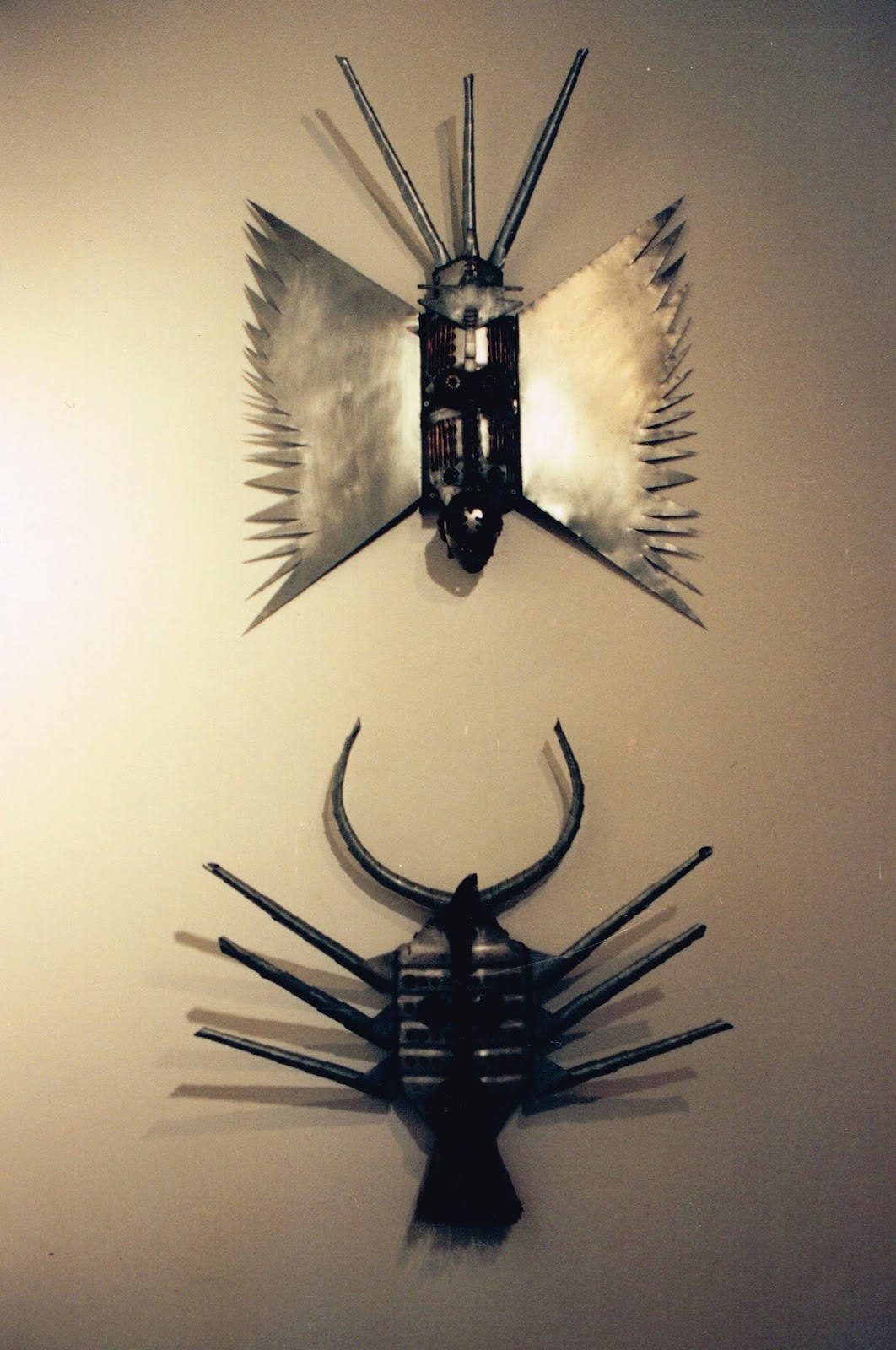
Awalay also posted part of his large collection of metal masks. As an artist, he collects, assembles and re-contextualizes found objects. These metal masks show a strong resemblance to ancient African wood-carved ones, but they Represent the perspective of an African descent in this Euro-centric society.
Hollis believes that art is a reflection of and commentary on what is happening in the world.
Awalay also showed very large, thought-provoking and challenging paintings. He told me he was inspired by the world renowned, late NYC painter of Haitian origin, Jean-Michel Basquiat. But Awalay/HollisBaptiste's work bears its own stamp of greatness. Awalay always works in 3 dimensions where Basquiat was strictly a painter.
Awalay asked me why I chose the colour I did when I arranged for the publicity production, because the painting is in fact bright red. I answered "It's the colour of old blood."
Awalay also posted part of his large collection of metal masks. As an artist, he collects, assembles and re-contextualizes found objects. These metal masks show a strong resemblance to ancient African wood-carved ones, but they Represent the perspective of an African descent in this Euro-centric society.
Hollis believes that art is a reflection of and commentary on what is happening in the world.
Awalay also showed very large, thought-provoking and challenging paintings. He told me he was inspired by the world renowned, late NYC painter of Haitian origin, Jean-Michel Basquiat. But Awalay/HollisBaptiste's work bears its own stamp of greatness. Awalay always works in 3 dimensions where Basquiat was strictly a painter.
Awalay continues to work today, now as Hollis Baptiste, but he has begun working with found plastic objects and even children's toys. He continues to explore new territory and to challenge boundaries. The last show of his I attended was in October 2013 at The Robert Kananaj Gallery.
Without Hollis' partnership as co-curator with me, by introducing me to other prominent black artists who were also doing high-quality work in Toronto at that time, I would not have been able to produce Representing: African Heritage in Contemporary Art.
Monday, 10 November 2014
Art as Politics
There was a time during the 90's when I was known as an Artists' Representative, and not as a graduate in Interior Design. So it was that for three weeks in February 1995 for Black History Month I produced and with the help of the artists themselves, curated, Representing African Heritage.
Six artists of African descent took possession of three large galleries at 80 Spadina. Representing African Heritage showed the state of contemporary black art in Toronto.
An art exhibit of this magnitude was a historic event for Toronto. Why? Because Representing comprised the most ambitious collection of quality work by artists of African descent that had up to this point in time been assembled in this city.
Its aim was to show Toronto African Heritage in the primary position.
Faki is a graduate of the University of Toronto, Faculty of Art and Art History. He was born in Lagos, Nigeria in 1969.
"The works I did between 1990 and 1992 were large and impregnated with the rage of my youth and African heritage."
This work is an woodcut done on sheets of plywood. The work is so large that it took one entire gallery room to contain it.
Representing African Heritage was filmed and now resides in the CBC archives.
I produced this large show privately, and since then this singular event has spawned yearly art exhibitions for Black History Month, all of them now corporate-sponsored.
Six artists of African descent took possession of three large galleries at 80 Spadina. Representing African Heritage showed the state of contemporary black art in Toronto.
An art exhibit of this magnitude was a historic event for Toronto. Why? Because Representing comprised the most ambitious collection of quality work by artists of African descent that had up to this point in time been assembled in this city.
Its aim was to show Toronto African Heritage in the primary position.
Faki is a graduate of the University of Toronto, Faculty of Art and Art History. He was born in Lagos, Nigeria in 1969.
"The works I did between 1990 and 1992 were large and impregnated with the rage of my youth and African heritage."
This work is an woodcut done on sheets of plywood. The work is so large that it took one entire gallery room to contain it.
Representing African Heritage was filmed and now resides in the CBC archives.
I produced this large show privately, and since then this singular event has spawned yearly art exhibitions for Black History Month, all of them now corporate-sponsored.
Subscribe to:
Posts (Atom)