Thursday, 8 January 2015

Representing African Heritage: Genius Reinvented

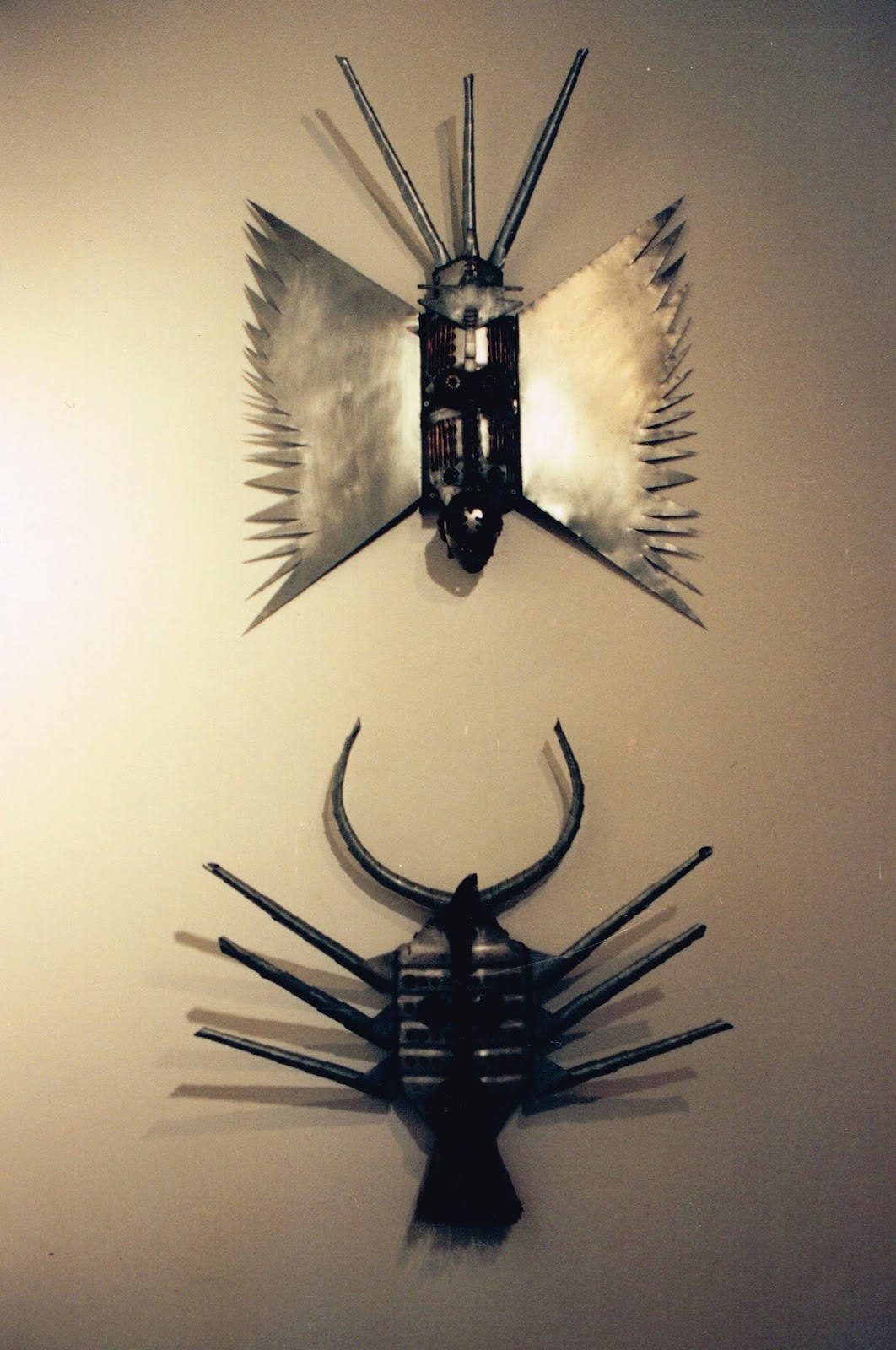
Owen Gordon has worked with Mokonde wood carvers from Africa in a cultural exchange program in Jamaica.  He has developed an internationally recognizable form of unique, elongated, carved wooden figures.

Owen's first one-man exhibition of sculpture was held at the Creative Arts Centre. U.W.I., St. Andrew, Jamaica.  His paintings and sculpture have been exhibited in several international art shows in England and the U.S.

Representing African Heritage featured many of Owen's vivid paintings and sculpture.  Owen also created 7 black pedestals to display his work, 3 long and tall, and 4 shorter and wider.  These pedestals were made to perfection, with the highest level of craftsmanship.


The aim of Representing African Heritage in Contemporary Art was to show that the genius of Africa continually reinvents itself, while retaining the vibrant palette, the ease of geometry, the mastery of abstraction, the sense of great energy in containment that are the unique properties of African art.  Its aim was to excite your eyes and kindle your imagination.


Here is one last, long, look at a powerful assemblage of Owen's sculptures on their pedestals.  His work filled most of one of the three galleries that took up one entire floor at 80 Spadina for this historic exhibit, the first of its kind in Toronto to celebrate Black History Month, in February 1995


I produced all aspects of Representing African Heritage in Contemporary Art with the partnership of Hollis Baptiste aka Awalay.  This historic show paved the way for all future corporate-sponsored art exhibits later assembled to honour Black History Month.  Similarly inspired exhibitions now occur with regularity every February.

Be sure to watch for these this coming month, Black History Month, February 2015

Friday, 26 December 2014

Poet as Priest: Auld Lang Syne

I had the privilege and honour of presenting Clifton Joseph and Jerome Morgan in a class I organized, February 2010, for African History at the Academy for Lifelong Learning.  Academy classes are held at Knox College, St. George Campus, University of Toronto.

The subject I chose was the West African griot tradition and how it reappeared, changed form and evolved in North America and the Caribbean, the African diaspora.  In West Africa, the griot is historian, story-teller, praise singer, poet and/or musician.

I linked it to classic rap which is what I am most familiar with, and at the beginning of the class played some on my ipod:  early Queen Latifah, Run DMC, and Quincy Jones, "The Verb to Be."

Then Jerome Morgan gave us his poem of early memories of Jamaica.  Jerome was mentored by d'bi young of the Dub Poets Collective

Clifton Joseph, founding member of the Dub Poets Collective, ended the set.  To my surprise, and probably everyone else there, he chose to sing the old Scottish Robbie Burns folk song written in 1788, Auld Lang Syne.  He ended his song in tears. 

"Should old acquaintance be forgot and never brought to mind
Should old acquaintance be forgot, and auld lang syne...
 
But we've wandered many a weary foot, since auld lang syne...
 
But seas between us broad have roared since auld lang syne.
And here's a hand, my trusty friend!  And give us a hand o'thine!
And we'll take a good-will draught, for auld lang syne."


There is a traditional dance that accompanies the singing of this song to ring in the New Year.  All persons cross arms over their chests and thus over their hearts to hold hands with their neighbour on either side and move the circle so formed inwards.

Somehow, as this dance continues, the circle participants then invert their arms to face outwards, and the circle moves in that direction.

The community forms a circle of protection, and then faces and moves outwards to welcome in the New Year, and the returning of the light.

In ancient Egypt in northern African, the blue lotus symbolized the sun and its return each morning.  It also represented the larger cycle of birth and rebirth.

The lotus is found in many major cultures.  In Buddhism, the pink lotus symbolizes the beauty of Enlightenment, purity and the cycle of creation.


At one time I had painted on my dining room ceiling the outer circle of a central Sun motif, originally painted on an American aboriginal bison robe.


So, now that the year is ending, we have seen the Winter Solstice, and we welcome back the sun and the beginning of a new year, new life and new creation, as every culture has done before us.

And mostly, we recall and often shed tears in memory of those whose shoulders we stand on.

Tuesday, 16 December 2014

Representing: Artist as Shaman

Representing African Heritage featured the artist Ras Stone, now known as Jah Stone. 

He is well known for his Caribana costume design.  His costumes have appeared in the Royal Ontario Museum (Quatzelcoatl-Canadian Celebrations, 1991) and Harbourfront (Sun God Worshipper - Festival of Lights, 1993).

His painting "Dread Preacher" was used by Saturday Night Magazine to illustrate an article in the November 1993 issue.

Jah Stone was born in Trinidad and emigrated to Canada in 1974.  You may find and follow him on Facebook as Jah Stone.

These are his paintings featured at Representing African Heritage.


Jah Stone's work has always used a strongly circular motif, and it continues to do so to this day.  He remains a prolific painter.

The circle is one of the most primordial images of mankind.  "The circle... represents totality.  Everything within the circle is one thing, which is encircled, enframed..."Mandala" is the Sanskrit word for "circle," but a circle that is coordinated or symbolically designed so that it has the meaning of a cosmic order." - Joseph Campbell, The Power of Myth.


The symbol of the sacred circle is found in all cultures.  In fact, all original cultures treated their art as sacred, and even used the circle when creating their everyday objects, so that these too carried a sacred blessing.


This Navaho sand painting is, by its very nature, temporary, yet it carries the weight of the divine.

Jah Stone may now truly be known as an elder and a priest through his art.  Search for him on Facebook, and follow both his ever-flowing work, and his blessings.

It is now the Christmas season, and time to contemplate where we each belong within this divine cosmic order.

Tuesday, 25 November 2014

Representing African Heritage

The star artist of Representing was Hollis Baptiste, aka Awalay.  His work was presented in the largest of the 3 galleries which took up one entire floor at 80 Spadina.  In this gallery, he used 3 of the 4 walls, including the heavy old pine support beams in this historic building, to showcase his work.


The large bright-red painting of the bright-blue skeleton holding a spear, and giving off powerful black arrows of vibration outwards from all around him, while standing on the black burial ground of white skulls is the one I used as the image for all the publicity posters and the hand-outs on Opening Night.  This bright skeleton almost seems to be in flames.

Awalay asked me why I chose the colour I did when I arranged for the publicity production, because the painting is in fact bright red.  I answered "It's the colour of old blood."


Awalay also posted part of his large collection of metal masks.  As an artist, he collects, assembles and re-contextualizes found objects.  These metal masks show a strong resemblance to ancient African wood-carved ones, but they Represent the perspective of an African descent in this Euro-centric society.   

Hollis believes that art is a reflection of and commentary on what is happening in the world.


Awalay also showed very large, thought-provoking and challenging paintings.  He told me he was inspired by the world renowned, late NYC painter of Haitian origin, Jean-Michel Basquiat. But Awalay/HollisBaptiste's work bears its own stamp of greatness.  Awalay always works in 3 dimensions where Basquiat was strictly a painter.


Awalay continues to work today, now as Hollis Baptiste, but he has begun working with found plastic objects and even children's toys.  He continues to explore new territory and to challenge boundaries. The last show of his I attended was in October 2013 at The Robert Kananaj Gallery.


Without Hollis' partnership as co-curator with me, by introducing me to other prominent black artists who were also doing high-quality work in Toronto at that time, I would not have been able to produce Representing: African Heritage in Contemporary Art.

Monday, 10 November 2014

Art as Politics

There was a time during the 90's when I was known as an Artists' Representative, and not as a graduate in Interior Design.  So it was that for three weeks in February 1995 for Black History Month I  produced and with the help of the artists themselves, curated, Representing African Heritage.

Six artists of African descent took possession of three large galleries at 80 Spadina.  Representing African Heritage showed the state of contemporary black art in Toronto.

An art exhibit of this magnitude was a historic event for Toronto.  Why?  Because Representing comprised the most ambitious collection of quality work by artists of African descent that had up to this point in time been assembled in this city. 

Its aim was to show Toronto African Heritage in the primary position. 


Faki is a graduate of the University of Toronto, Faculty of Art and Art History.  He was born in Lagos, Nigeria in 1969.

"The works I did between 1990 and 1992 were large and impregnated with the rage of my youth and African heritage."


This work is an woodcut done on sheets of plywood.  The work is so large that it took one entire gallery room to contain it.


Representing African Heritage was filmed and now resides in the CBC archives. 

I produced this large show privately, and since then this singular event has spawned yearly art exhibitions for Black History Month, all of them now corporate-sponsored.

Friday, 24 October 2014

The Politics of Colour

Every year, the Interior Design cognoscenti choose a paint colour of the year.  Acccording to Leatrice Eiseman at Pantone Paints, "choosing the colour of the year has to do with the zeitgeist or the psychology of the colour and what it says to people."

For the year 2014, that colour was christened "Radiant Orchid," and it has had varying degrees of acceptance.  It is a strong pink, with blue undertones.  I have asked myself whether the current and continual year-by-year use of the colour pink, has in effect been accepted as a reflection of our current "princess" culture for very young girls.  In the past, pink has rarely been used in Interior Design.
 

I look back at the long reign of neutrals, from the mid-1990's up until today, featured in many interiors in publication after publication, almost ad nauseum.  Interior Designers have even been advising their clients to paint over lovely, solid oak woodwork and to make it white.  Why is unknown to me, because highlighting woodwork, which is not usually an architectural feature, especially in newer-built homes, seems counter-productive.  Woodwork can rarely be a focal point.

One thing that puzzles me greatly is the long sway held by the colour yellow-green, chartreuse, or variations of the same.  It began in 1995 and continues to this day, usually now seen as an accent colour.


Here I am at a party given in 1996, when this colour first came into fashion.  I am wearing a dyed-to-match Designer blouse and skirt.  And I even bought a short wool jacket, also to dyed-to-match this outfit!

The fall of 2008, when Lehman Brothers in NYC fell was a watershed moment.  It began the "Great Recession," which we still have not recovered from, and may well never, in quite the same way as we might have expected to.

Since that time, bright colours have slowly crept back into the paint box of Interior Designers, probably as a way to ward off economic gloom.  Now, we are most likely to see blues of all variations, light, bright and dark used extensively in Interior Design.  I believe that this colour mirrors the appreciation that the need for fresh water on this planet is growing increasingly urgent.


We are not yet seeing much green, especially true greens, such as emerald.  But I believe we will soon, because this colour is beginning to appear in Fashion Design.

Where red was once highly favoured for dining rooms, this colour is not seen as frequently now, as it once was.


It's amusing and also curious to me how the Interior Design pundits can sometimes get it so horribly wrong.  During the year 2012, orange or tangerine was declared "colour of the year" at the IDS in Toronto.  Orange is the colour MacDonald's uses, and why?  They use it so as to make their customers eat and run, because of the inherent discomfort the colour causes to those surrounded by it!

In general, I think it can safely be said that the "hot" colours, such as red, orange and yellow are not very popular in Interior Design these days, other than as accents, because of our generalized discomfort with global warming.

I think you might safely conclude that the customer is always right!

Friday, 10 October 2014

One simple act for nature has exponential beneficial results

Earlier on this page I posted a photo of a Common Ninebark, a native Ontario species, purchased from www.yourleaf.org, which I planted in the wild area of my small backyard.

Previously, my son-in-law had dug up for me all of the garlic mustard which, as an invasive species native to Italy, had taken over my yard.  I believed at the time that it would simply return.

But a surprise awaited me!  After planting only my Common Ninebark, and allowing it to get established, this year it bore fruit all summer.  (It proved to be very hardy too over this year's previous hard winter!)

The result of this has been that many birds have visited it to feast on its fruit, thus leaving their droppings behind.  Suddenly I find that all manner of Ontario indigenous plants, or "weeds," if you must, have come back to take root in my garden. 


A goldenrod has become resident.


Milkweed, the Monarch butterfly's only food source is now flourishing.


And here are some photos of other wild, flowering plants which have established themselves, whose names I don't know.  But I recognize them from the meadows of my childhood.

So you see, just one simple act of planting a native Ontario shrub, the Common Ninebark, from www.yourleaf.org has brought diversity back to my yard.  Incidentally, it amuses me to remember that 15 years ago, the City of Toronto ordered me to cut down all these offending plants in favour of a putting down a lawn.  However, this City of Toronto policy is no longer in place.

Yeah!